7 min
Marla, Kanal and Bigha: What They Actually Measure
One Marla is 272.25 square feet and one Kanal is exactly twenty of them. Bigha is not one unit at all. The exact factors, and where they stop being exact.
Nearly every materials estimate that comes up short does so for the same reason, and it is not the arithmetic. It is that a mix ratio describes loose dry ingredients while the order is placed in finished concrete, and those are two different volumes.
12 min read · updated 8 September 2026 · links to 10 tools
1:2:4 means one part cement to two parts sand to four parts coarse aggregate, measured by loose volume. On site that has always meant buckets, head pans or a gauge box, which is exactly why the convention exists: it is a proportion anyone can follow without a weighbridge.
What it does not mean is one kilogram of cement to two of sand. It also does not mean one bucket of cement makes seven buckets of concrete. Both readings are common and both under-order, for two separate reasons that this guide takes in turn.
The ratio also says nothing about water, which is the single biggest influence on the strength of the result. Water is deliberately outside the ratio because the right amount depends on how wet the sand already is on the day.
Dry sand and cement are mostly air. Sand grains do not pack perfectly, cement is a fine powder full of voids, and coarse aggregate has large gaps between stones. When water is added it fills those gaps, the cement paste coats every particle, and the whole thing settles into a smaller volume than the loose materials occupied on the ground.
The standard allowance for that is 1.54. Multiply the wet volume you want by 1.54 and you get the loose dry volume you have to buy. A slab that needs 1 m³ of concrete needs 1.54 m³ of dry material, not 1 m³ of it.
Order 1 m³ of ingredients for 1 m³ of concrete and you receive 1 ÷ 1.54, which is 64.9% of what the pour needs. You are 35% short — and you find out with the mixer running.
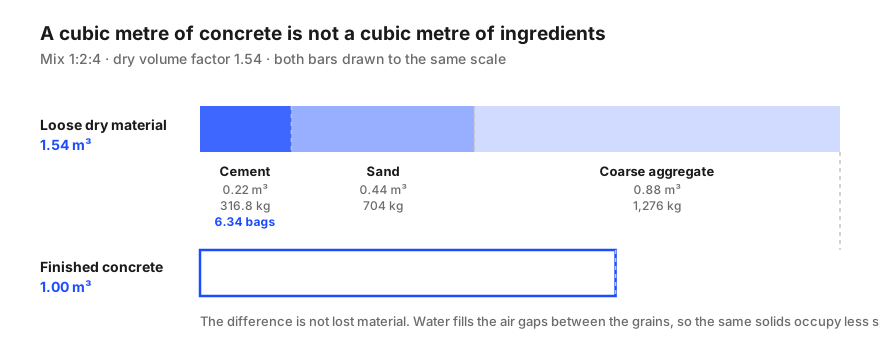
Everything below is per cubic metre of finished concrete, at a dry volume factor of 1.54 and loose bulk densities of 1,440 kg/m³ for cement, 1,600 for sand and 1,450 for coarse aggregate. Cement bags are 50 kg. A 50 kg bag occupies about 0.0347 m³, which is worth knowing because it is how you check a delivery by eye.
| Mix | Nominal grade | Cement | Sand | Coarse aggregate |
|---|---|---|---|---|
| 1:3:6 | M10 | 4.44 bags · 221.8 kg | 0.462 m³ · 739 kg | 0.924 m³ · 1,340 kg |
| 1:2:4 | M15 | 6.34 bags · 316.8 kg | 0.440 m³ · 704 kg | 0.880 m³ · 1,276 kg |
| 1:1.5:3 | M20 | 8.06 bags · 403.2 kg | 0.420 m³ · 672 kg | 0.840 m³ · 1,218 kg |
| 1:1:2 | often quoted as M25 | 11.09 bags · 554.4 kg | 0.385 m³ · 616 kg | 0.770 m³ · 1,117 kg |
Cement comes in bags, but sand and crush are usually quoted by the cubic foot or by the trolley. One cubic metre is 35.31 cubic feet, so the 1:2:4 row above is 15.54 cubic feet of sand and 31.08 of aggregate for every cubic metre of concrete.
That conversion is where a second error creeps in, because a trolley is not a fixed unit and a "100 cubic foot" load is a nominal description of the vehicle rather than a measured quantity. If you are checking a delivery, check the volume of the heap, not the name of the vehicle.
A batching plant weighs its materials, and the moment you convert a volume ratio into weights the numbers stop being round. Each material has its own bulk density, so multiplying equal volume shares by unequal densities gives unequal weight shares.
For 1:2:4 at the densities above, the weight proportions come out as 1:2.22:4.03. The sand part rises because sand is denser than cement in loose bulk; the aggregate part barely moves because 1,450 is close to 1,440. Neither shift is large enough to notice on a small job and both are large enough to matter on a big one.
This is the whole reason a weigh-batch page takes the three densities as inputs rather than hard-coding them. Change the source of your sand and the weight ratio changes with it, even though the bucket ratio on the drawing has not.
Cement hydrates with roughly a quarter of its own weight in water. Everything beyond that is there to make the mix workable, and it leaves behind capillary pores as it evaporates. Those pores are why strength falls as the water-to-cement ratio rises — steeply, and with no way to recover it later.
The ratio is water weight divided by cement weight, and since a litre of water weighs a kilogram it is easy arithmetic. For the 1:2:4 mix above, with 316.8 kg of cement:
| Water/cement | Water per m³ of 1:2:4 | Typical use |
|---|---|---|
| 0.40 | 126.7 litres | Structural, with a plasticiser to keep it workable |
| 0.45 | 142.6 litres | Reinforced work, good exposure |
| 0.50 | 158.4 litres | General reinforced concrete |
| 0.55 | 174.2 litres | Mass concrete and non-structural work |
| 0.60 | 190.1 litres | Above this the loss of strength is serious |
This is the part that quietly ruins otherwise careful batching. Sand delivered to a site is rarely dry. At 5% moisture the 704 kg of sand in a cubic metre of 1:2:4 is carrying about 33.5 litres of free water before anyone opens a hose.
Add the full 158.4 litres on top of that and the batch is at 0.61, not 0.50 — a ratio intended for mass concrete, poured into a reinforced slab. The mix will look right, place well and cure weak.
The arithmetic matters because moisture content is quoted on the wet weight of the sand, so the free water is not simply 5% of 704. It is 704 × 0.05 ÷ 1.05, which is why the water-cement page asks for the moisture of each aggregate separately and subtracts what they bring.
| Sand moisture | Free water it brings | Actual w/c if you still add 158.4 L |
|---|---|---|
| 3% | 20.5 litres | 0.56 |
| 5% | 33.5 litres | 0.61 |
| 8% | 52.1 litres | 0.66 |
A grade like M20 means a characteristic compressive strength of 20 N/mm² at 28 days on a standard cube, defined so that no more than 5% of test results fall below it. It is a statement about what the concrete achieved.
1:1.5:3 is a nominal mix — a proportion you can follow without testing anything, which is expected to land somewhere near M20 with ordinary materials and ordinary care. The pairing in the table above is a convention, not an identity, and the whole point of the word "nominal" is that the strength is not guaranteed by the recipe.
For anything structural, and in the codes above M20, the answer is a design mix: proportions arrived at by trial batches with your actual cement, your actual aggregate grading and your actual water, then verified by cube tests. The ratio then stops being a rule of thumb and becomes a measured result.
This is worth being blunt about. If a drawing specifies a grade, the grade is the requirement and no ratio on this page satisfies it on its own.
A 25 kg bag of pre-mixed concrete yields about 0.0166 m³, so a cubic metre takes 61 bags. That is roughly a tonne and a half to carry, open and mix by hand, which is the real cost long before the price of the bags is.
Ready-mix is cheaper per cubic metre but rarely sold below a minimum load, and under that load you pay for the load anyway plus a short-load fee. So bags are a staircase — you buy whole bags — and ready-mix is flat below the minimum and linear above it. Two different shapes, and they cross.
Where they cross depends entirely on local prices, which is why the comparison page walks both curves with your own numbers instead of quoting a universal break-even. As a rough orientation: below a quarter of a cubic metre bags almost always win, above one cubic metre ready-mix almost always does, and the interesting decisions live between.
A mix ratio prices the concrete. It does not price the pour. Three other quantities usually cost more than people expect, and all three are geometry rather than chemistry.
Formwork is charged by contact area, not by the volume it contains, so a thin deep beam costs far more per cubic metre than a slab does. Reinforcement is priced by weight and estimated by spacing, and the arithmetic contains a trap: dividing a clear span by the bar spacing gives the number of gaps, not the number of bars, and the lap lengths at every splice add several per cent on top of the measured runs. Masonry, if the pour is a footing under a wall, needs its own count.
Every figure here assumes ordinary Portland cement, clean well-graded aggregate and normal conditions. Admixtures, blended cements, lightweight or recycled aggregate, hot or freezing weather, and any structural requirement all change the answer, and some change it a great deal.
These pages are estimating tools. They will tell you what to buy and where a quantity does not add up. They are not a substitute for a specification, and nothing here should override a drawing, a bar bending schedule or an engineer who has seen the site.
One Marla is 272.25 square feet and one Kanal is exactly twenty of them. Bigha is not one unit at all. The exact factors, and where they stop being exact.
Showers are about half of household water, and a silent running toilet can beat everything else combined. The breakdown, and what actually pays back.