12 min
What a Gold Rate Actually Buys
A rate is meaningless without a purity and a unit. 22K at a 24K rate overpays by 9.09%, and one tola is 11.6638038 g exactly.
Ramadan is earlier every year, your Hijri birthday does not sit still, and two converters can hand you dates a day apart. All three have the same cause, and it is not that anyone is calculating badly.
11 min read · updated 12 September 2026 · links to 8 tools
The moon takes about 29.53 days to go from one new moon to the next. Twelve of those is 354.367 days. The earth takes 365.2425 days to go round the sun. The Islamic calendar counts moons; the Gregorian counts the sun.
The gap is 10.876 days a year, and it does not accumulate into a correction — there is no leap month. The Hijri calendar is not trying to stay aligned with the seasons, which is the part that surprises people used to a solar calendar where a date means a time of year.
So a Hijri date simply walks backwards through the Gregorian year, about eleven days at a time, until it arrives back where it started roughly 33.6 years later.
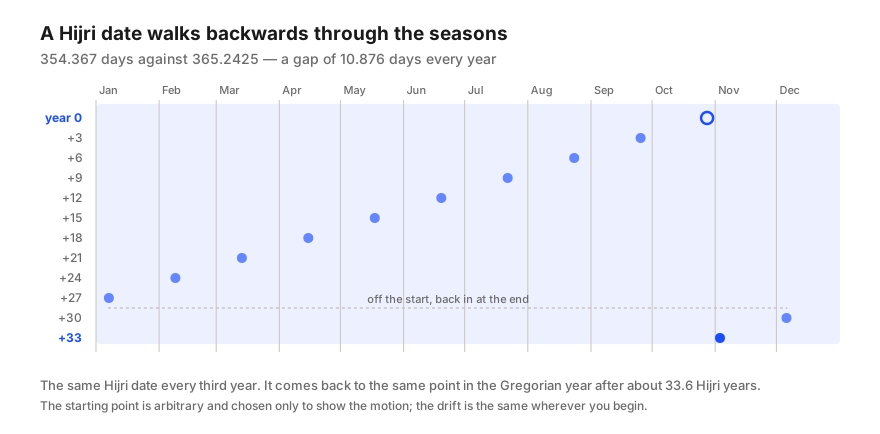
Because the drift is about eleven days a year, Ramadan passes through the entire solar year over roughly three decades. Fast in a Pakistani June and the days are long and hot; fast in a December and they are short and cool.
Over a lifetime that evens out, which is the point. A lunar calendar shares the difficulty around rather than fixing it permanently on one hemisphere or one season. A solar-fixed Ramadan would be mild forever in one part of the world and punishing forever in another.
Half the cycle — the swing from the longest days to the shortest — takes about 16.8 years.
Nearly every Hijri converter, including the one on this site, uses the tabular Islamic calendar. Months alternate 30 and 29 days, the year is 354 days, and in 11 years out of every 30 an extra day is added to the final month, making 355.
That gives a mean year of exactly 10631 ÷ 30 = 354.3667 days. Twelve true lunar months average 354.367056. The arithmetic calendar is within about 0.012 days of the moon across a whole 30-year cycle — roughly a quarter of an hour every thirty years.
The conversion runs through the Julian day number, a plain count of days from a fixed point, which is why both directions are exact inverses of one another: convert a date across and back and you get the same date, always.
| Quantity | Value | Note |
|---|---|---|
| Mean synodic month | 29.530588 days | new moon to new moon |
| Twelve lunar months | 354.367056 days | the astronomical lunar year |
| Tabular Hijri year | 354.3667 days | 10,631 days per 30-year cycle |
| Gregorian year | 365.2425 days | mean, including the leap rule |
| Drift | 10.876 days a year | the whole story in one number |
| Full circle | about 33.6 Hijri years | back to the same season |
| Epoch | 16 July 622 CE | 1 Muharram 1 AH, by this convention |
This is the question that brings most people to a converter, and the answer is not that one of them is wrong.
The tabular calendar decides in advance, by arithmetic, when each month begins. Observance in most places begins the month when the new crescent is actually seen, which depends on the weather, the observer, the horizon and the local rules about what counts as a sighting. An arithmetic prediction and a human observation are simply not the same kind of statement.
So a printed calendar, a converter, a government announcement and a neighbouring country can disagree by a day, and occasionally by two. Saudi Arabia publishes the Umm al-Qura calendar, which is calculated by yet another set of rules again, so even two calculated calendars need not match.
The practical division: use a converter for records, arithmetic, forms and anniversaries, where a stable answer everyone can reproduce is what you need. Use the local announcement for observance, because that is what observance means.
If lunar years are shorter, more of them have passed. The conversion is just the ratio of the two year lengths, and it works out at about 3.1% more.
Someone 30 Gregorian years old is about 30.9 Hijri years old. At 40 it is 41.2, and at 60 it is 61.8. The gap widens with age, reaching a full extra year at around 33.
That is also why the two birthdays only coincide about once every 33 years, and why a Hijri birthday recorded on an old document will not line up with the Gregorian date someone remembers.
| Gregorian age | Hijri age | Difference |
|---|---|---|
| 20 years | about 20.6 | +0.6 |
| 30 years | about 30.9 | +0.9 |
| 33 years | about 34.0 | +1.0 — a full extra year |
| 40 years | about 41.2 | +1.2 |
| 60 years | about 61.8 | +1.8 |
Zakat is due after a full lunar year — a hawl — of holding wealth above the nisab. A lunar year, not a calendar year.
The consequence is easy to miss when you track it on a Gregorian calendar: each year it falls due about eleven days earlier than the last, and over 33 Gregorian years you will have paid it 34 times, not 33.
Anyone reckoning their zakat date by "the same month as last year" will slowly drift out of step. Fixing the anniversary to a Hijri date, and converting it, is what keeps it honest — and the nisab itself is a weight of metal rather than a sum of money — 87.48 g of gold or 612.36 g of silver, 7.5 and 52.5 tola — so its value in money moves every day as well.
It is worth separating these, because they sit in the same part of life and work in completely different ways.
The date is lunar. The times within the day are solar: each prayer is defined by where the sun is, so the geometry depends on your latitude, your longitude and the day of the solar year, and not at all on the Hijri date.
The calculation is precise to well under a minute. What varies is convention — the twilight angle used for fajr and isha differs between methods by enough to move those two times by up to twenty minutes, and the asr shadow ratio differs by school. Above about 48° of latitude the summer twilight never fully ends, and a rule has to be substituted for the geometry.
The same Julian-day machinery converts several other systems, and each solves the lunar-solar problem differently, which makes the comparison genuinely useful.
The Hebrew calendar is lunisolar: it counts months by the moon but inserts a thirteenth month seven times in nineteen years, which keeps Passover in spring. The Persian calendar is solar and is one of the most accurate ever devised, tied to the astronomical spring equinox.
Set beside them, the Islamic calendar is the one that deliberately does not correct, and that choice is what produces the drift this whole page is about.
It cannot tell you when Ramadan begins where you live. Nothing calculated can, because in most places that is settled by a sighting and an announcement.
It also cannot resolve a historical date to a certainty it never had. Dates from centuries ago were recorded under local sighting practices that are not recoverable, so a converted historical date is a reasonable reconstruction, not a fact.
A rate is meaningless without a purity and a unit. 22K at a 24K rate overpays by 9.09%, and one tola is 11.6638038 g exactly.
One Marla is 272.25 square feet and one Kanal is exactly twenty of them. Bigha is not one unit at all. The exact factors, and where they stop being exact.