7 min
Marla, Kanal and Bigha: What They Actually Measure
One Marla is 272.25 square feet and one Kanal is exactly twenty of them. Bigha is not one unit at all. The exact factors, and where they stop being exact.
A gold rate on its own is not a price. It is a price per unit of weight, at one particular purity, and if either of those two is wrong the number underneath it is wrong by several per cent — on a purchase where several per cent is real money.
12 min read · updated 9 September 2026 · links to 13 tools
This is the first thing to get straight, because the two spellings are used interchangeably almost everywhere and they mean nothing like the same thing.
Karat, with a K, describes purity as a fraction of twenty-four. 24K is the whole thing; 22K is 22 parts in 24; 18K is 18 in 24, which is three quarters. It is a ratio and it has no units.
Carat, with a C, is a mass unit for gemstones, defined as exactly 0.2 grams. A one-carat diamond weighs 0.2 g. It says nothing whatever about gold, and converting carats to grams is a completely separate operation from reading a karat.
The confusion is harmless right up until someone reads "18 carat" as a weight or "2 carat" as a purity, and then it is not harmless at all.
Fineness expresses the same ratio in parts per thousand: karat ÷ 24 × 1000. It is what the stamp on a piece of jewellery is quoting, and it is the number a refiner or an assayer will use.
For most karats the stamp and the arithmetic agree exactly. For three of them they do not, because the hallmark is a rounded figure that had to be a whole number.
| Karat | Fineness by arithmetic | Gold by weight | Hallmark | Mark vs arithmetic |
|---|---|---|---|---|
| 24K | 1000 | 100% | 999 | below — nothing refined commercially is exactly pure |
| 22K | 916.67 | 91.67% | 916 | below by 0.67 |
| 21K | 875 | 87.5% | 875 | exact |
| 18K | 750 | 75% | 750 | exact |
| 14K | 583.33 | 58.33% | 585 | above by 1.67 — the largest gap on the list |
| 10K | 416.67 | 41.67% | 417 | above by 0.33 |
| 9K | 375 | 37.5% | 375 | exact |
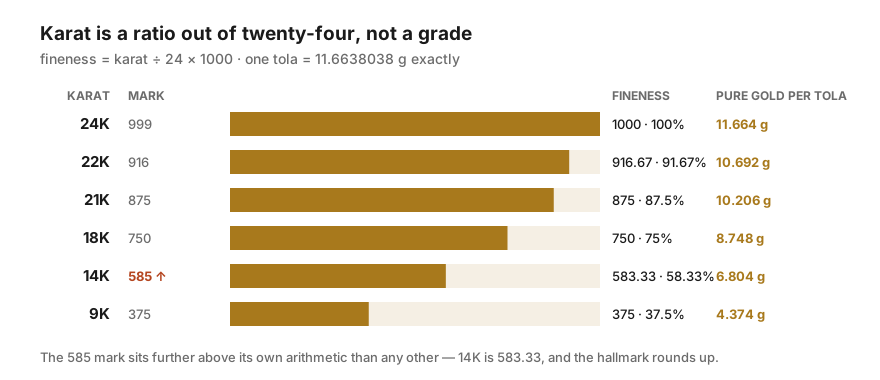
One tola is 11.6638038 grams. That is not a rounded figure or a local convention — it is 0.375 troy ounces exactly, which is three eighths of a troy ounce, and it is defined against the kilogram with no offset and no approximation.
It divides further into 12 masha and 96 ratti, and the same weight is called a bhori in Bangladesh. The conversion is one multiplication in either direction, and the reverse gives 0.0857353 tola to the gram.
The reason this matters commercially is that gold is quoted per tola across Pakistan, India, Bangladesh, Nepal and much of the Gulf, while it is quoted per gram or per troy ounce almost everywhere else. Comparing a local rate to an international one means converting both the unit and the purity, and getting only one of them right produces a number that looks plausible and is not.
| Unit | In grams | Exactly |
|---|---|---|
| 1 tola | 11.6638038 g | 0.375 troy ounce |
| 1 troy ounce | 31.1034768 g | 2.6667 tola |
| 1 gram | — | 0.0857353 tola |
| 10 grams | — | 0.8574 tola |
| 1 carat (gemstone) | 0.2 g | a weight, not a purity |
Newspaper and association rates are almost always for 24K, and the jewellery in the shop is almost always 22K or 21K. Converting between them is one multiplication — the 24K rate times the karat over 24 — and it is the single most useful piece of arithmetic on this page.
At a 24K rate of 300,000 per tola: 22K metal is worth 275,000, 21K is 262,500, and 18K is 225,000. Those are metal values before any making charge.
Pay the full 24K rate for 22K metal and you have overpaid by 9.09% of what the metal is actually worth. That is not a rounding difference; on one tola at these numbers it is 25,000.
The reverse trap is quieter. The 22K price sits 8.33% below the 24K price, and 8.33% and 9.09% are not the same number even though they describe the same gap — the first is measured against the larger figure, the second against the smaller. If you are checking a bill, be clear which direction you are computing.
Above the metal value sits the cost of turning metal into an object: making charges, sometimes quoted as a percentage and sometimes as a flat amount per gram or per tola, plus wastage, plus whatever tax applies locally.
At a 22K metal value of 275,000 per tola, a piece with 12% making costs 308,000. That extra 33,000 bought labour and design. It did not buy gold.
When you sell, you are selling metal. A jeweller buys back at the metal value — often a little under it — and the making charge is simply gone. So the piece has to gain 12% in metal value before selling it returns what you paid, and that is before any deduction for testing or refining loss.
None of which makes jewellery a bad purchase. It makes jewellery a purchase, which is a different thing from an investment, and the numbers are worth seeing before deciding which one you are making.
Old jewellery is valued on what it contains, not on what it cost. The arithmetic is the same in both directions: gross weight times karat over 24 gives the pure gold, and that pure weight times the rate per gram gives the metal value.
A 40 g piece of 22K holds 36.67 g of pure gold. At 21K it would hold 35 g. The four-gram difference between two pieces that look identical is why the karat has to be established before any number is agreed.
Mixing works the same way in reverse. Bringing a quantity of one karat up or down to another is a question of how much pure gold and how much alloy are already present, which is arithmetic rather than judgement — and the mixing page shows each step so a jeweller's figure can be checked rather than accepted.
The nisab — the level at which zakat becomes due — is defined as a quantity of metal: 87.48 g of gold or 612.36 g of silver. In tola those are almost exactly 7.5 and 52.5, which is where the familiar figures come from.
Because the threshold is a weight, its value in money changes every day with the market, which is why no calculator can store it. The silver threshold is usually much the lower of the two in money terms, and which one to use is a question of scholarship rather than arithmetic.
The rate itself is 2.5%, one fortieth, on net zakatable wealth held for a full lunar year. The calculator does the arithmetic and shows each step, including which threshold you crossed and by how much.
Every figure here is metal content and unit conversion. None of it is a price forecast, an appraisal, or advice about whether to buy.
Purity claims cannot be verified from a photograph, a receipt or a stamp, and a piece can be plated, filled or hollow in ways that no weight-and-karat arithmetic will reveal. Where the amount matters, the answer is a test, not a calculation.
One Marla is 272.25 square feet and one Kanal is exactly twenty of them. Bigha is not one unit at all. The exact factors, and where they stop being exact.
A 50% markup is a 33% margin. Getting the two confused underprices products by a third, and the error compounds through every tier below you.