8 min
Why One Cup of Flour Is Not One Cup of Sugar
A cup is a volume and a gram is a mass, so there is no single cups-to-grams number. Here is why flour is the worst offender and how to measure it properly.
Almost every first-batch problem in candle making is one of three arithmetic mistakes, and none of them is about candles. They are about the difference between weight and volume, the direction a percentage runs in, and what a rate actually measures.
9 min read · updated 30 August 2026 · links to 6 tools
A 300 ml jar does not take 300 g of wax. It takes 300 millilitres of wax, and soy wax weighs about 0.90 g per millilitre, so a jar filled to 90% takes roughly 243 g.
Ordering by the jar's stated volume as if it were a weight over-orders by about 11%, every jar, every batch. On a run of twelve that is most of a kilogram of wax you did not need.
There is a second route to the same number that is worth knowing, because it does not depend on the jar's stated volume being accurate: fill the jar to your pour line with water, weigh the water, and multiply by the wax density. Water is one gram per millilitre by definition, so the two methods agree exactly — and on an oddly shaped jar the water is a measurement while the stated volume is a manufacturer's claim.
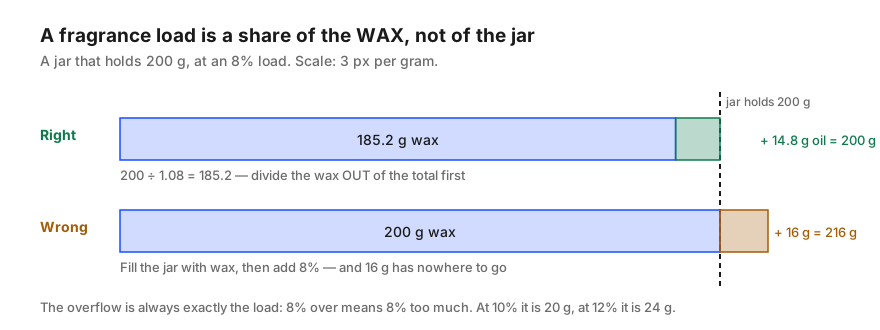
A fragrance load is quoted as a percentage of the wax, and it is an addition rather than a share. 200 g of wax at 8% takes 16 g of oil and pours 216 g in total — more than the wax you started with.
That is fine when you know the wax weight. The problem is that you usually know the jar, and the jar holds a fixed total. Fill it with 200 g of wax and then add 8% and you have 216 g trying to fit into a 200 g jar. The overflow is exactly the load, every time.
The wax has to be divided out of the total first: 200 ÷ 1.08 = 185.2 g of wax, leaving 14.8 g of oil. That inversion is the single most useful piece of arithmetic in container candle making, and it is the one most first batches get backwards.
Fragrance oils differ in density, so millilitres are not interchangeable between one oil and another. Every figure worth using in candle making is in grams, and a scale reading to 0.1 g is the cheapest thing you can buy that improves consistency between batches.
There is also a ceiling. Each wax holds only so much oil before it stops absorbing it and the oil separates out — beads on the surface, an oily film, a wick that struggles. Soy is commonly said to hold around 10%, beeswax considerably less. The ceiling is a property of the wax and the oil together, so your supplier's figure for the pairing you are actually using beats any general number.
Burn time is weight divided by burn rate. A 243 g candle at 7 g per hour lasts about 34 hours and 43 minutes, and running it backwards returns the same 243 g, which is the check that the arithmetic is honest in both directions.
The rate is the interesting part, and it does not follow the amount of wax. It follows the melt pool diameter. Make a candle bigger by using a wider jar and the rate rises with it, so the burn time goes up far less than the weight does — and the burn time per gram actually falls. Make it bigger by using a taller jar of the same diameter and the time really does roughly double.
That is why "hours per gram" only compares candles of the same width, and why a large three-wick can burn through its wax faster than a small single-wick.
Everything above is calculation. Wick sizing is not, and it is worth being blunt about that.
The right wick depends on the wax, the fragrance load, the dye, the container glass and the wick series itself, and every supplier numbers their series differently. A chart can narrow the first test from a dozen candidates to two or three. It cannot replace the test.
Both ways of being wrong cost you, and one matters more. Too small and the melt pool never reaches the edge: the candle tunnels, most of the wax never burns, and the scent stays in the jar. Too large and the flame runs high, the candle soots, and the container gets hotter than it should — which in glass is the failure that actually matters. When you are between two sizes, test the smaller one first.
A candle's materials cost is five lines — wax, fragrance, wick, container, and the label and box. On most container candles the jar and the fragrance are larger than the wax, which is why switching to a cheaper wax rarely rescues a unit cost and sourcing jars better often does.
If you sell, margin and markup are different numbers and confusing them always errs towards charging too little. Margin is the share of the selling price you keep; markup is what you added to the cost. A 50% markup is a 33% margin.
And the figure that compares two candles honestly is cost per burn hour. A small expensive candle and a large cheap one cannot be compared on price, but they can on what an hour of burning costs — which is what a customer is actually buying.
A clamshell cavity is quoted by what it holds, and what it holds is wax plus fragrance. At a 10% load a 20 g cavity is 18.18 g of wax and 1.82 g of oil.
So 900 g of wax fills 49 cavities, not the 45 you get by dividing 900 by 20. That division treats the fragrance as though it were wax and under-counts by the whole load — which is how a tray comes up short at the end. Melts also run at a higher load than candles, because there is no wick and no flame: the oil is released by a warmer rather than burnt off.
A cup is a volume and a gram is a mass, so there is no single cups-to-grams number. Here is why flour is the worst offender and how to measure it properly.