8 min
Margin vs Markup, and Why the Difference Costs Money
A 50% markup is a 33% margin. Getting the two confused underprices products by a third, and the error compounds through every tier below you.
Two lenders quote you ten per cent. One of them is charging you two thirds more than the other, and nothing in the quoted number tells you which. The word that decides it is usually somewhere in the small print, and it is often only one word long.
11 min read · updated 9 September 2026 · links to 8 tools
Interest is rent on money. The whole question is which money — everything you originally borrowed, or only what you still have.
A reducing-balance loan charges you on what you still owe. In month one that is the full amount; by the last month it is almost nothing. This is what banks use for mortgages and what every loan calculator on this site computes.
A flat-rate loan charges you on the original amount for the entire term, regardless of how much you have repaid. In the final month, when you owe almost nothing, you are still paying interest as though you owed all of it.
The second method is common on car finance, consumer instalment plans, dealership schemes and a great deal of informal lending, precisely because it produces a smaller-looking number for the same amount of money.
Borrow 1,000,000 over 60 months.
Quoted as 10% flat, the arithmetic is deliberately simple, which is part of the appeal. Interest is 1,000,000 × 10% × 5 years = 500,000. Total repayable is 1,500,000. Divide by 60 and the instalment is 25,000.
Quoted as 10% reducing balance, the instalment is 21,247 and the total repaid is 1,274,823, of which 274,823 is interest.
The gap is 225,177 — the flat version charges 82% more interest for the same headline rate. And that is the honest comparison, because both loans were quoted at ten per cent.
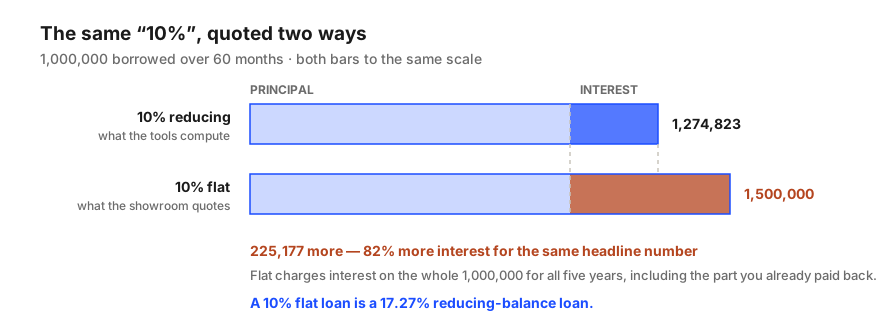
Take the flat loan payment of 25,000 a month and ask what reducing-balance rate would produce it on 1,000,000 over 60 months. The answer is 1.4395% a month, which is 17.27% a year — or 18.71% once monthly compounding is counted.
So the honest description of a 10% flat loan over five years is: a 17.27% loan. That is the number to put beside a bank offer, and it is the number the quote does not contain.
The multiplier is not a constant, and this is the part most rules of thumb get wrong. It depends on the term, and not in the direction people expect.
| Term | Quoted flat | True reducing-balance rate | Multiplier |
|---|---|---|---|
| 1 year | 10% | 17.97% | 1.80× |
| 2 years | 10% | 18.16% | 1.82× |
| 3 years | 10% | 17.92% | 1.79× |
| 5 years | 10% | 17.27% | 1.73× |
| 7 years | 10% | 16.66% | 1.67× |
On the reducing-balance loan the amount you owe falls every single month, so the interest charged falls with it. Over five years the average balance you owe is a little over half the original amount — which is roughly why the true rate is a little under twice the flat rate.
The flat loan ignores that entirely. It sets the interest once, at the start, against the full amount, and then splits the result into equal instalments. By the final year you are paying interest on money that has been back in the lender's hands for years.
That is the whole mechanism. There is nothing hidden or dishonest about the arithmetic itself — flat interest is a legitimate and openly used method. What is misleading is quoting it as a percentage without saying which percentage it is, next to competitors quoting the other kind.
There is one comparison that cannot be gamed. Fix the amount and fix the number of months, then ask every lender for the monthly payment. The lowest payment is the cheapest loan. It does not matter what either of them calls their rate.
Ask for the total repayable as well, since payment times term is the number the quoted rate is hiding. On the example above, 1,500,000 against 1,274,823 settles the question in a way that "ten per cent" against "ten per cent" never could.
If a lender will not state a monthly payment and a total repayable for a specific amount and a specific term, that reluctance is itself the answer.
Even on an honest reducing-balance loan there is a second thing worth seeing, because it decides what happens if you want to settle early.
Take 1,000,000 over 60 months at 20% a year. The instalment is 26,494. In the first month, 16,667 of that is interest and only 9,827 — 37% of the payment — reduces what you owe.
After 30 payments, half the term, you still owe 621,490. You have paid 794,820 and cleared 378,510 of the loan. The balance does not fall in a straight line, and any plan that assumes it does will be wrong by a wide margin.
This is not a trick either. It is what charging interest on the outstanding balance necessarily produces, and it is why a month-by-month schedule is worth looking at before signing rather than after.
On a reducing-balance loan, an extra payment goes straight against the principal, every future month's interest is computed on a smaller balance, and the saving compounds. Paying early is one of the highest-return things available to most borrowers.
On a flat-rate loan the interest was fixed at the start. Settling early may reduce the remaining instalments a little or may reduce them not at all, depending entirely on the contract's rebate clause. In the worst case you repay the same total sooner, which is strictly worse than keeping the money.
So "can I pay it off early, and what exactly does that save?" is a question to ask before signing, and to get answered as a number rather than as a reassurance.
Even the true reducing-balance rate is only the interest. Arrangement and processing fees, compulsory insurance, documentation and valuation charges, late fees and early-settlement penalties all sit outside it, and some of them are large enough to change which offer is cheaper.
This is why regulators in many countries require an APR or an effective rate that folds the mandatory fees into a single figure. Where such a number is given, it is the one to compare. Where it is not, add the fees to the total repayable yourself and compare the totals.
For readers considering Islamic finance products — murabaha, ijara, diminishing musharaka — the pricing is structured differently and the underlying contract is not a loan at all. The same discipline still applies to comparing offers: ask for the total payable and the monthly amount for a specific sum over a specific term, and compare those.
Every loan tool on this site computes reducing balance, because that is what the standard amortising formula describes and what a bank instalment actually is. To model a flat-rate offer, work out its total repayable, divide by the number of months, and then use the payment to find the equivalent reducing-balance rate — which is exactly what this page did above.
None of these pages is financial advice, none knows your circumstances, and none can see the contract in front of you. They do arithmetic, they show their working, and they are meant to be used to check a number somebody else has given you.
A 50% markup is a 33% margin. Getting the two confused underprices products by a third, and the error compounds through every tier below you.
A rate is meaningless without a purity and a unit. 22K at a 24K rate overpays by 9.09%, and one tola is 11.6638038 g exactly.