8 min
Why One Cup of Flour Is Not One Cup of Sugar
A cup is a volume and a gram is a mass, so there is no single cups-to-grams number. Here is why flour is the worst offender and how to measure it properly.
A glucose result of 100 and a glucose result of 5.6 can be the same blood, drawn from the same arm, on the same day. The number changes because the unit changes, and the unit changes because of where the laboratory is.
8 min read · updated 30 August 2026 · links to 9 tools
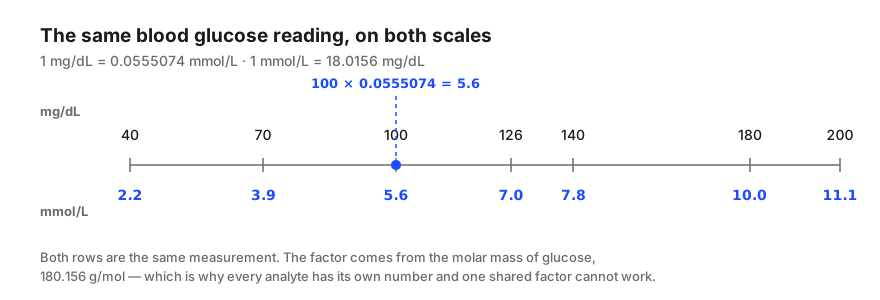
A fasting glucose of 100 mg/dL is 5.6 mmol/L — the glucose converter does that one. A total cholesterol of 200 mg/dL is 5.2 mmol/L. Neither pair is an approximation of the other — they are the same measurement in two different units, in the same way that 12 inches and 1 foot are the same length.
Which one you get depends on the laboratory. The United States, and to varying degrees a handful of other countries, report in mg/dL. Most of Europe, Australia, Canada and much of Asia report in mmol/L. Neither is more correct. The friction appears when you move between systems: a result printed abroad, a study quoted in a different unit, an app that assumes one convention, or a family member comparing numbers across a border.
This is the part that trips people up, and it is worth understanding rather than memorising.
A concentration in mg/dL is a weight of substance in a volume of blood. A concentration in mmol/L is a count of molecules in a volume of blood. To get from a weight to a count you have to know how much one mole of that substance weighs — its molar mass — and every substance has a different one.
Glucose has a molar mass of about 180.16 g/mol, which produces the factor 0.0555074 used by the mg/dL to mmol/L page. Cholesterol is a much larger molecule at about 386.65 g/mol, so its factor is 0.0258629 — less than half. Triglycerides are larger still. Apply glucose's factor to a cholesterol result and the answer is more than twice what it should be.
That is the whole reason this site carries a separate converter for each analyte rather than one box with a dropdown of "blood tests". The dropdown would be the bug.
Multiply the mg/dL figure by the number in the third column to get the SI figure. Divide to go the other way. Creatinine and uric acid are the odd ones out: they are reported in micromoles rather than millimoles, because the concentrations are so much smaller.
| Analyte | SI unit | mg/dL × this | Worked example |
|---|---|---|---|
| Glucose | mmol/L | 0.0555074 | 100 mg/dL = 5.6 mmol/L |
| Total cholesterol | mmol/L | 0.0258629 | 200 mg/dL = 5.2 mmol/L |
| HDL cholesterol | mmol/L | 0.0258629 | 50 mg/dL = 1.3 mmol/L |
| LDL cholesterol | mmol/L | 0.0258629 | 130 mg/dL = 3.4 mmol/L |
| Triglycerides | mmol/L | 0.0112939 | 150 mg/dL = 1.7 mmol/L |
| Urea nitrogen (BUN) | mmol/L | 0.356972 | 15 mg/dL = 5.4 mmol/L |
| Calcium | mmol/L | 0.249513 | 9.5 mg/dL = 2.37 mmol/L |
| Creatinine | µmol/L | 88.4033 | 1.0 mg/dL = 88.4 µmol/L |
| Uric acid | µmol/L | 59.4845 | 6.0 mg/dL = 357 µmol/L |
Total, HDL and LDL cholesterol all convert with 0.0258629, because they are all measuring cholesterol — the same molecule, carried by different lipoproteins. The fractions differ; the substance does not.
Triglycerides are genuinely different molecules and have their own factor, which is why a lipid panel needs two factors rather than one even though it prints as a single block of results.
Haemoglobin is usually reported in g/dL rather than mg/dL, and its SI form is mmol/L — but the conversion depends on whether the laboratory expresses it per haemoglobin monomer or per tetramer. Different countries have historically done both, which means a haemoglobin figure converted without knowing the convention can be out by a factor of four.
This is the one on this list where it is genuinely worth checking what your laboratory reports rather than trusting any converter, including ours. The tool states which convention it uses on the page.
A converted number is still just a number. Reference ranges differ between laboratories, between assay methods and between populations, and a result that is normal in one range can be flagged in another. The unit conversion is exact arithmetic; the interpretation is not arithmetic at all.
Nothing on this page, and nothing in the converters it links to, is medical advice or a diagnosis. They exist to answer one narrow question — what is this same measurement in the other unit — and to answer it with the right factor for the right substance. Everything past that belongs to the person who ordered the test.
A cup is a volume and a gram is a mass, so there is no single cups-to-grams number. Here is why flour is the worst offender and how to measure it properly.